6.037
11 (Wed) Feb 2015
Taste Test : Hetbahn, Supplemented
3.0
by CJ CheilJedang
in my apartment
-Ermita, Manila-
with MK+CS, KK, TL
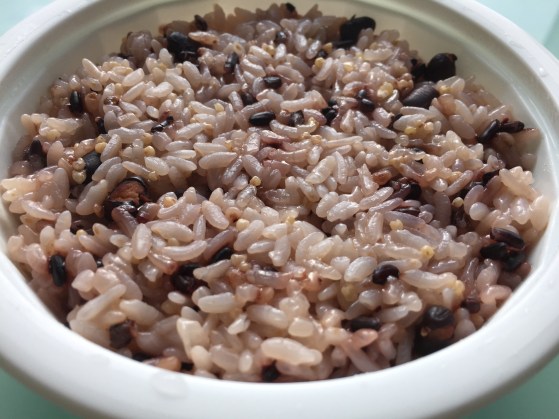
While Koreans typically prepare rice by steaming it plain, they also like to add supplements, such as grains and/or legumes, for deeper flavor, boosted nutrition, prettier appearance. I don’t know of any other food culture that does so, at least not during the initial steam.


Hetbahn is a semi-instant rice product invented by the Korean food company CJ CheilJedang. Consists of cooked rice that’s partially condensed and vacuum-packed in a plastic bowl. Reheated/reanimated in a microwave oven for a couple minutes, the rice comes out perfect, exactly like freshly steamed rice, but better because the consistency is precise every time–indeed, the slogan in Korean is “Rice that tastes better than rice.” Other companies now make the same kind of product (see for example 6.021 Bibimbap), each under a different brand name (e.g., “haepssal”)–more or less the same in quality–but the original is so famous that “hetbahn” has now become the generic term for them all (e.g.,”aspirin”).


As a follow-up to their plain hetbahn (see for example 6.023 Flavored Seaweed), CJ has developed a series of supplemented rice cups in 5 varieties: (1) Rice & Black Bean, (2) Five Grains, (3) Barley Rice, (4) Black Rice, (5) Sprouted Brown Rice.
I invited the gang over to help me conduct a taste test of all 5 varieties.
An ideal accompaniment for rice with its spicy and salty components, I prepared budae jjigae.

The rice cups were fine. Texturally, each turned out perfectly, as hetbahn always does. In terms of flavor, I preferred the ones in which the supplements were more subtle, taking a secondary role to the rice. However, I couldn’t really tell that much difference between them when drowned in budae jjigae–which, given its overpowering quality, may not have been the best choice to facilitate a taste test, come to think of it (kinda like how a whole wheat bun wouldn’t really stand out in, say, a meatball sub loaded with sauce and cheese). But they all felt more healthful (like wheat bread). And looked nicer (like wheat bread). So, although I wouldn’t go out of my way to obtain them, I’d buy if available, why not.
In ascending order of preference: